
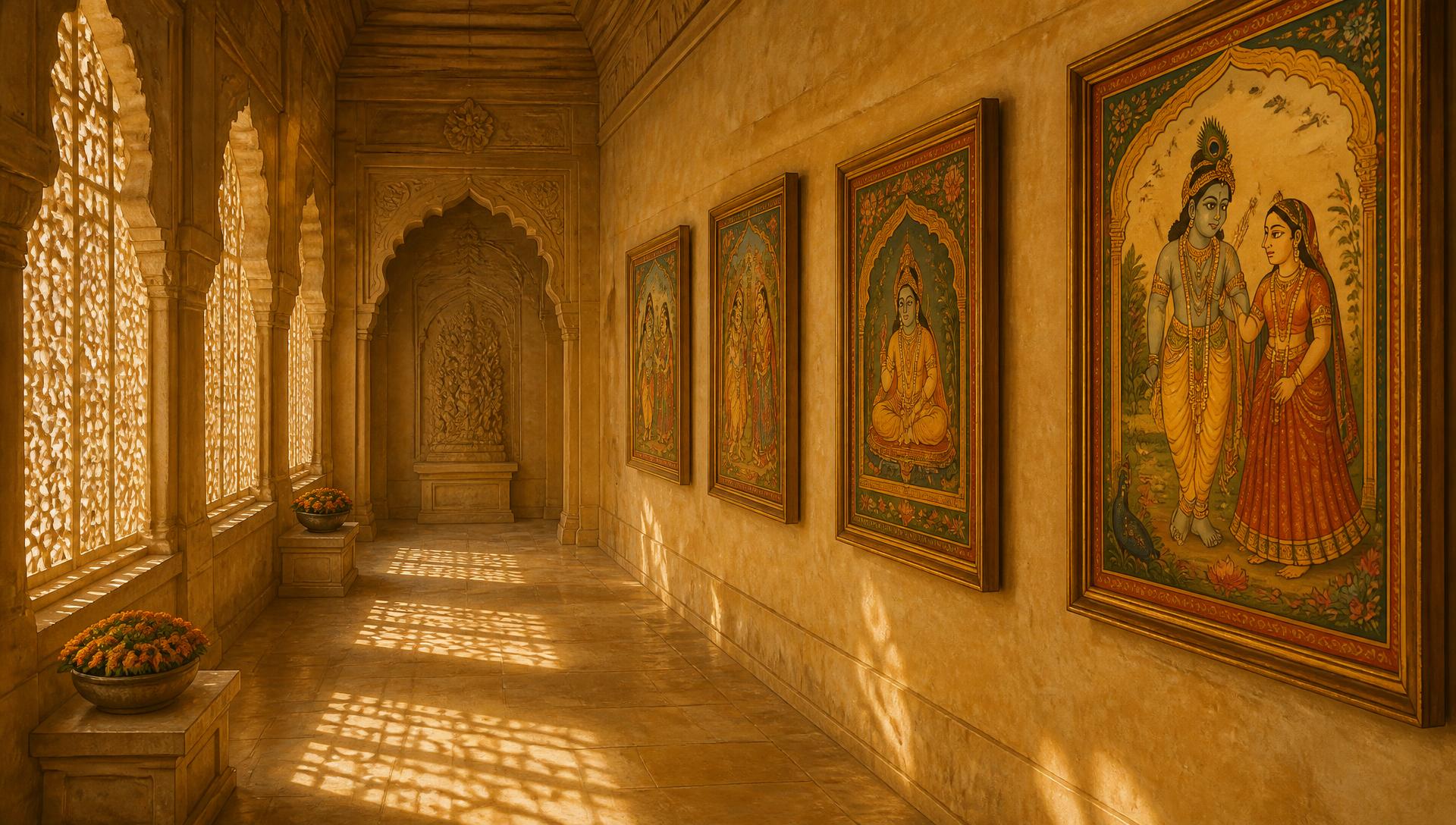
A sunlit sandstone corridor hung with traditional Indian paintings

The Chitrashala

Saisri Art

Where Little Hands Carry Ancient Traditions

Saisri Art

The Story of Saisri

Some artists spend a lifetime searching for their calling. Saisri found hers at the age of three.

In the ancient Gurukul tradition of India, a child's education began not with textbooks — but with observation, imitation and practice under a master. Children as young as five were initiated into the arts — because India always knew that the earlier a seed is planted, the deeper the roots grow.

Saisri's story is no different.

Born in Freising, Germany, to a family rooted in the rich cultural traditions of South India, Saisri picked up a brush at the age of three — and never put it down. What began as a child's instinct for colour and form evolved, year by year, into something extraordinary — a disciplined, passionate and deeply knowledgeable young artist who paints not just with her hands, but with the weight of India's 5,000-year artistic civilisation behind her.

Today, at just 11 years old, Saisri has mastered art forms that most artists never attempt in a lifetime. She has learned from the ancient texts of Shilpashastra, painted in the 400-year-old tradition of Pichwai, brought to life the 2,500-year-old language of Madhubani, explored modern art and sketching, and crafted the Japanese art of Amigurumi with extraordinary skill.

Saisri Art is her registered business — and every piece she creates is a meeting point between ancient India and the modern world.

The Art Forms

A Journey Through India

Shilpashastra

The Root of All Indian Art

Shilpashastra represents the ancient Indian science of creative arts — sculpture, iconography and painting — rooted in the Vedas and Puranas, believed to have originated from the Vishwakarma community, the divine lineage of craftsmen who built the temples and cities of ancient India.

In ancient Indian literature, Shilpa signifies any form of art or craft, while Shastra represents science. Together, Shilpa Shastra refers to the scientific study of arts and crafts.

Shilpashastra is not a single text — it is an entire library of knowledge, covering sculpture, painting, architecture, iconography, temple construction and the cosmic principles that govern all of them. It is the grammar of Indian art. Every temple, every sculpture, every painting in India traces its rules back to this ancient science.

To learn Shilpashastra is to learn the foundational language of Indian civilisation itself. Saisri has studied this language. Everything she creates is rooted in it.

Pichwai

400 Years of Krishna on Canvas

Pichwai paintings are one of India's most intricate and spiritually rich traditional art forms — originating in the 17th century in Nathdwara, Rajasthan, initially created as intricate cloth hangings to adorn the backdrop of Lord Krishna's idol in the Shrinathji Temple.

The word Pichwai comes from Sanskrit — Pichh meaning back and Wai meaning hanging — literally, that which hangs at the back of the deity.

Creating a Pichwai can take several months and requires immense skill — as the smallest details need to be painted with precision. Pichwai artists use fine brushes, gold and silver leaf, and natural pigments to create compositions of extraordinary richness — lotus flowers, cows, festival processions, Krishna's divine play — each element carrying layers of symbolic meaning encoded over centuries.

In Saisri's hands at age 11, this 400-year-old tradition finds a new home — in Freising, Bavaria.

Madhubani

The Art Born at Sita's Wedding

The origin of Madhubani painting can be traced back over 2,500 years to the Ramayana — when King Janaka of Mithila commissioned the first Madhubani painting to celebrate the wedding of his daughter Sita to Lord Rama.

Madhubani painting originated in the Mithila region of Bihar — practised for centuries by the women of the region, passed from mother to daughter, generation after generation, on the mud walls of homes during festivals, weddings and sacred ceremonies.

Artists traditionally used twigs, matchsticks, bamboo pens and their own fingers as brushes — and colours derived from turmeric, indigo, lampblack and flowers. This is not just painting. It is a 2,500-year-old conversation between a woman, her community and the cosmos.

Saisri brings this conversation to Germany.

Modern Art & Sketching

Where Tradition Meets Freedom

Alongside her classical training, Saisri explores modern art and sketching — giving her a rare and precious dual fluency. She can move from the strict iconographic rules of Shilpashastra to the open freedom of contemporary expression — a bridge between India's ancient visual language and the modern world.

This duality is what makes Saisri truly extraordinary. She is not just preserving tradition. She is expanding it.

Amigurumi & Crochets

Where Yarn Becomes Magic

Amigurumi — the Japanese art of crocheting small, stuffed yarn creatures — is Saisri's most playful and tactile art form. Each piece is handcrafted, unique and full of personality — from adorable animals to imaginative characters that seem to have a life of their own.

What makes Saisri's Amigurumi extraordinary is not just the skill — but the fact that every single piece is made by an 11-year-old's hands, with patience, precision and a love for craft that is deeply moving.

Saisri Art

The Shop

Every piece in Saisri Art is:

  • Handmade — no two pieces are alike
  • One of a kind — each carries its own story
  • Made with love — by an 11-year-old who lives and breathes art

Paintings and Amigurumi are available to purchase. Pricing varies with each piece — because no two pieces are the same.

For enquiries, commissions and purchases, please get in touch.

Commissions & enquiries on WhatsApp

A Note from Saisri

“I paint because it makes me happy. Every colour, every stitch, every line — is a little piece of me.”

Saisri Art — Ancient traditions. Little hands. Big dreams.